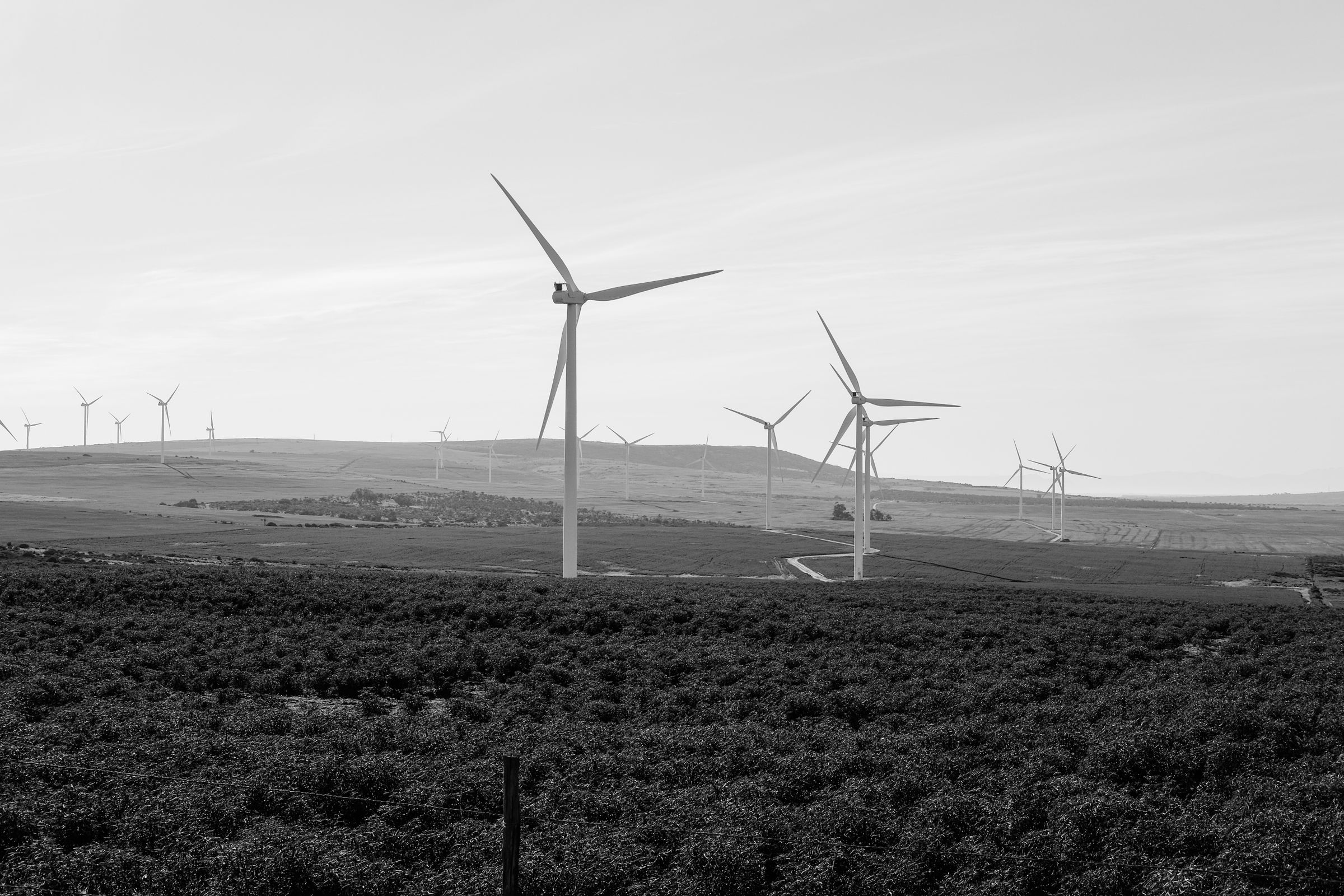
De Aar's 163 Wind Turbines Deliver Power, Promises Lag
Turbines run, but water, roads and local contracts stall in the Northern Cape
The 163 turbines above De Aar have been turning since 2017, feeding roughly 770 million kilowatt-hours a year into the national grid, enough for an estimated 300,000 households. The machines work. The question hanging over the Northern Cape town is whether the delivery promised alongside them ever will.
The wind farms are controlled by Longyuan South Africa Renewables, a subsidiary of China Energy Investment Group, which holds the controlling stake in a consortium that includes South African developer Mulilo, DLO Energy Resources Group and a local community trust. The project was awarded under the Renewable Energy Independent Power Producer Procurement Program and sells its power to Eskom under a 20-year agreement, with debt reportedly from South African lenders including Nedbank and the Industrial Development Corporation. Eskom is the buyer, not the owner, and what the project owes its host community is shaped by South African procurement rules as well as by the investor.
What residents say is missing is specific: roads, water, jobs, and contracts for local firms rather than outside companies. They say they have registered businesses that could create more jobs and should be prioritized. Land is a further grievance. Sandile Makandula, chairperson of the Emthanjeni Business Chamber, which represents businesses in De Aar, Britstown and Hanover, says he asked the municipality’s local economic development office for the title deeds to the land the IPPs occupy and it appears they do not have them. All the projects, he says, operate under lease agreements.
Water is where delivery has broken down most visibly. Much of De Aar has faced shortages that disrupted operations at its four health facilities, with local reporting describing three years of repeated outages, parts of town dry for more than two weeks, and households relying on JoJo tanks and water tankers. Makandula says Longyuan Mulilo offered to help fund a borehole, but the initiative stalled amid friction with the municipality, and he blames gatekeeping and community liaison officers who do not understand their duties. A proposed youth center in Nonzwakazi met a similar fate; the old one, burned down a decade ago, stands vandalized, and children play and sleep there. “Longyuan Mulilo proposed building something big, but because of the struggle within the municipality, they ended up pulling out,” Makandula says. Efforts to get Longyuan Mulilo to comment on why the borehole and the youth center stalled were unsuccessful.
Meanwhile, the municipality’s own reporting points to strain on its side. The Emthanjeni Municipality Report 2024/2026 states that vandalism of water infrastructure led to increased maintenance costs, service disruptions and reduced reliability of the water supply. The Emthanjeni Municipality says it shares the community’s expectations. Mayor Lulamile Nkumbi, reached through a journalist colleague at the 16 July inauguration of TotalEnergies’ Hydra solar-and-battery project, a joint venture of Power China International, said the municipality is negotiating for more renewable projects and agreed pressure is needed for IPPs to deliver local business and jobs. “We need more collaboration, understanding, and a strong relationship to ensure that the community is the beneficiary of the project, which is hosted by Emthanjeni,” he said, while cautioning that not everyone will end up in business.
The books behind that caution are thin. The municipality has received a qualified audit opinion from the Auditor-General in each of the past five years, recorded an accounting deficit of about R196 million on revenue of about R296 million in 2024/25, and holds current liabilities of R749 million against current assets of R420 million, according to National Treasury data. In 2024 the Department of Water and Sanitation opened a criminal case over the dilapidated De Aar wastewater works, idle for more than two years. Census 2022 counted about 10,600 households in Emthanjeni, roughly 7% not on a municipal or regional water scheme and about 1% with no toilet.
There is evidence cooperation can function. Over five years the municipality partnered with Longyuan Mulilo and DLO Energy Resources Group on a skills program for young people; more than 110 young technicians have been trained, and local employees make up more than 80% of the workforce, according to an Electrical Technology Facebook post. The Mulilo De Aar Solar Community Trust has sponsored schools in the municipality’s three towns with buses and trailers, though Makandula says the gesture is undercut by poor consultation: “Public participation was not done properly, where Independent Power Producers come and ask the community what your needs and expectations are. You just find IPPs arrive with a proposal saying, ‘we want to do this’.” He objects to the sequence, since schools are the provincial education department’s responsibility, and says developers should first address needs communities themselves identify.
By contrast, not all operators work the same way. Leon Thulo, a security guard at Juwi, a new solar project by a German renewable energy company, credits German firms with transferring skills to local youth, including cleaning and maintaining solar panels. TotalEnergies says 45% of Hydra’s construction workforce came from the De Aar area, and developer SolarAfrica, whose 114-megawatt SunCentral 1 plant was built by PowerChina, reports employing 655 local people and training 80 small businesses. Residents’ complaints about consultation and local contracts target the IPPs as a group, not only the Chinese-linked ones, and De Aar hosts producers of many nationalities, including TotalEnergies, Juwi and South African firms alongside Chinese contractors such as PowerChina.
The accounts point to a three-way gap rather than a single culprit: developers that consult late and fund what is easiest to deliver, a municipality short of money and capacity, and gatekeeping intermediaries standing between residents and companies. Trust has frayed among all three, and no single party, Chinese, European or South African, can repair it alone. The turbines deliver power under national rules; water, roads and the relationship between residents and their municipality remain local work that has yet to be taken on altogether. A fuller account of the accountability questions raised here appears at https://chinaglobalsouth.com/analysis/chinas-renewable-energy-projects-south-africa-local-accountability/. Whether De Aar’s next round of renewable projects closes that gap, or repeats it, may depend on which of the three parties moves first.
Q&A
Who operates the De Aar wind farms and under what commercial arrangement?
Longyuan South Africa Renewables, a subsidiary of China Energy Investment Group, controls the consortium that includes Mulilo, DLO Energy Resources Group and a local community trust. The project was awarded under the Renewable Energy Independent Power Producer Procurement Program and sells power to Eskom under a 20-year agreement, with debt reportedly from Nedbank and the Industrial Development Corporation.
What happened to the borehole and youth center that Longyuan Mulilo proposed?
Both stalled. Makandula says Longyuan Mulilo offered to help fund a borehole, but the initiative stalled amid friction with the municipality, which he blames on gatekeeping and community liaison officers who do not understand their duties. The proposed youth center in Nonzwakazi was abandoned after the old one burned down a decade ago; the operator pulled out because of struggles within the municipality. Longyuan Mulilo did not comment on why either stalled.
What is the state of the Emthanjeni Municipality's finances and infrastructure?
The municipality has received a qualified audit opinion from the Auditor-General in each of the past five years, recorded an accounting deficit of about R196 million on revenue of about R296 million in 2024/25, and holds current liabilities of R749 million against current assets of R420 million. In 2024 the Department of Water and Sanitation opened a criminal case over the De Aar wastewater works, idle for more than two years, and the municipality's own report cites vandalism of water infrastructure as raising maintenance costs and reducing supply reliability.
Is there evidence that renewable operators can deliver local benefits in De Aar?
Yes. A five-year skills program with Longyuan Mulilo and DLO Energy Resources Group trained more than 110 young technicians, and local employees make up more than 80% of the wind farm workforce. TotalEnergies says 45% of Hydra's construction workforce came from the De Aar area, Juwi's German operators are credited with transferring solar panel maintenance skills, and SolarAfrica reports employing 655 local people and training 80 small businesses at its 114-megawatt SunCentral 1 plant.