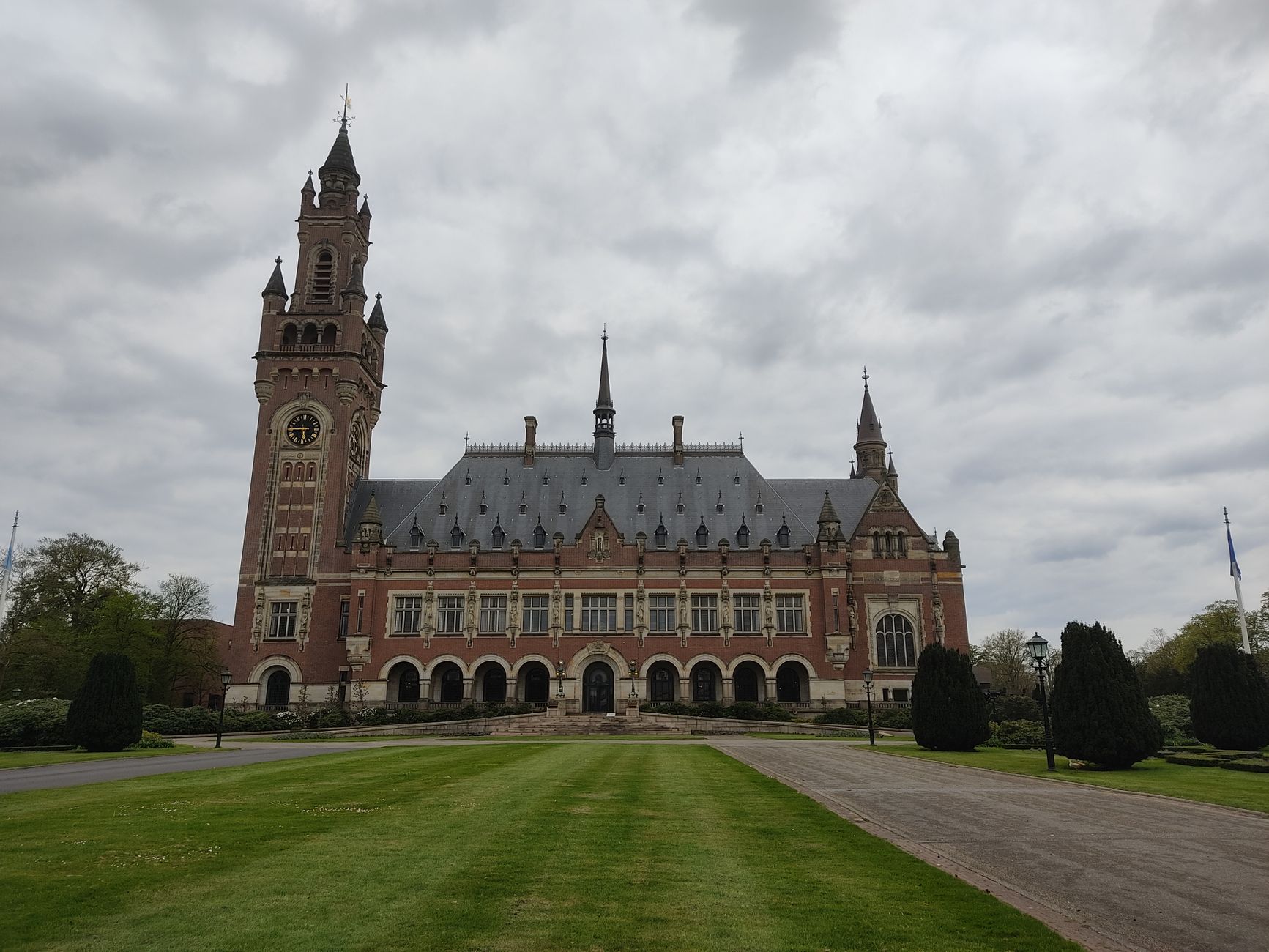
George Galloway has directly challenged the South African government to close the gap between its litigation strategy and its trade policy, urging Pretoria to halt coal exports to Israel on the grounds that continued sales are incompatible with the genocide case the country has brought before the International Court of Justice.
Speaking to the Mail & Guardian in Cape Town, the veteran British politician argued that South Africa, having instituted proceedings at the ICJ in December 2023 alleging violations of the Genocide Convention in Gaza, should match its legal position with economic measures. “We’ve accused this country of genocide. We really can’t sell them coal at the same time,” he said. In his view, ending the exports would resolve what he regards as a contradiction between Pretoria’s case and its continued trade with Israel. “Why not take the moral high ground and say, well, we think you’re guilty of genocide, so we can hardly fuel your economy?”
Galloway put figures to the trade relationship. About 3% of South Africa’s coal exports go to Israel, he said, while claiming they constitute 27% of Israel’s coal imports. “It’s significant for them, but not that significant for you,” he said, arguing that alternative markets could be found, including China and Vietnam.
The legal case at the centre of the challenge remains unresolved. The court has issued three sets of provisional measures but has yet to rule on the merits of South Africa’s genocide allegation, which Israel rejects. South Africa maintains that Israel has failed to comply with the court’s orders, and in August Pretoria submitted a further dossier to the ICJ detailing what it said was Israel’s continued non-compliance with the provisional measures.
Galloway said he remained deeply sceptical about the ability of international courts to protect Palestinians, since they have no independent means of enforcing their decisions. That did not diminish the significance of South Africa bringing the case, he insisted. “The moral power of a positive finding by the ICJ will spur the solidarity movement,” he said. Whatever the eventual judgment, he argued, the case had already achieved something substantial: “It has re-energised the international solidarity movement. It has put South Africa front and centre.”
The proceedings, he said, had also revived attention to Nelson Mandela’s declaration that South Africa’s freedom would be incomplete without the freedom of Palestinians. “It reminded everyone that, whatever the disappointments, and clearly there are a lot of disappointed people in South Africa, the liberation movement did not lose sight of its historic purpose.”
More broadly, Galloway called on BRICS countries to play a greater role in international affairs, contending that existing institutions had failed to restrain powerful states. He singled out China, saying its political influence still lagged behind its economic weight and that Beijing could do more on Palestine.
Meanwhile, Galloway linked South Africa’s present role to the international solidarity movement during apartheid, recalling what he described as the strategy of “the hammer and the anvil”: resistance within South Africa combined with international solidarity abroad. The same principle applied to Palestine, he said. “The Palestinians cannot liberate Palestine on their own. They need an anvil. But you still need the hammer, or the anvil’s useless.”
The response to his South African tour, he said, reflected the depth of public support for Palestine, and he urged South Africans not to underestimate its significance. “There’s nowhere in the world that you could get the kind of support for Palestine that you get in South Africa.” For Galloway, that support was rooted in the country’s own history. “It exists because of the struggle.”
Further details of the interview are available at https://mg.co.za/news/south-africa/2026-10-02-galloway-calls-for-end-to-israel-coal-exports/.